Importing routes
In this section it is explained how to import a route from a geodata file, from an url and how to import routes shared by Topo GPS users.
Importing routes from geodata files
It is possible to import routes in Topo GPS in the following file formats: gpx, kml/kmz, geojson and ozi explorer track files (plt). Files of these types can also be imported if they are compressed in a zip file.
To import a route you could try to tap on a file icon. Most often an app picker will show up. Sometimes you need to scroll through the list of apps or tap More to find “Topo GPS”. You then have to tap “Open with Topo GPS” or “Copy to Topo GPS” and the file will be imported in Topo GPS.
Sometimes it is convienient to use drag and drop. This can even be done on an iPhone. Press and hold your finger on the file, item or URL. Then move your finger to drag it. Move the item into the Topo GPS main maps screen. On an iPhone, drag and drop works only if you use two fingers. After you have pressed and hold the item, you have to open the app switcher with a second finger by swiping the screen upwards at the bottom. Now still holding the first finger, you can use your second finger to switch to Topo GPS. If you are at the main map screen you can drop the file here. It will then be automatically imported.
Alternatively you could also tap Menu > More > Import file. Then the files app will be opened. Here you can select a cloud storage, like iCloud, Dropbox, OneDrive or Google Drive. Then you can browse through your files and select the files you want to import.
If the routes were imported successfully, you will return to the main screen, and the map will be zoomed to the imported routes. The imported routes will be saved on your device and can be found back in the routes screen.
Importing route from URL
If you have an URL, a convient way to import is to press long on it and use drag-and-drop to drag it into the Topo GPS main screen as explained above.
For example dragging a link on a webpage to a gpx file into Topo GPS, might be a convenient way of importing a route.
Alternatively, you press long on an url to a geodata file and copy it to your pasteboard. Then open the routes screen and select the tab “Routes”. Tap “More > Import URL” to open the URL import screen. Here you can paste your URL. Then tap “Import” to import the URL.
If the routes were imported successfully, you will return to the main screen, and the map will be zoomed to the imported routes. The imported routes will be saved on your device and can be found back in the “Routes” tab of the routes screen.
Importing routes shared by Topo GPS users
To import routes shared by other Topo GPS users, first open the routes pop-up (Menu > Routes). Then tap the item “Shared routes”. The shared routes screen will be opened as in the example below:
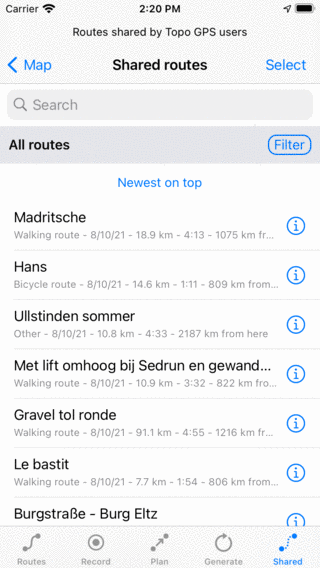
The shared routes screen.
The shared routes screen displays routes which are stored on the Topo GPS server and shared by other Topo GPS users. You can search, filter and sort these routes just like you can with your saved routes. Applying a filter can help you to find for example bicycle routes near your current location, as in the example below:
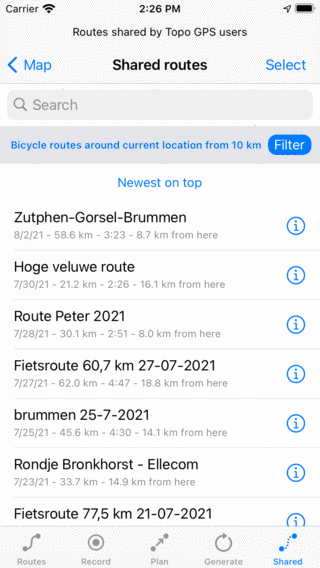
Searching bicycle routes of minimal 10 km length around your current location.
If you tap a route title in the list it will be immediately imported and you will return to the main screen. You can tap long on an item or tap “Select” on the top right to enter the selection mode. Then you can select multiple routes and import them at once.
If you tap the info button (i) next to a route the route details screen of a shared route will be opened. Sometimes it will take a few seconds before all route data is downloaded. An example is shown below.
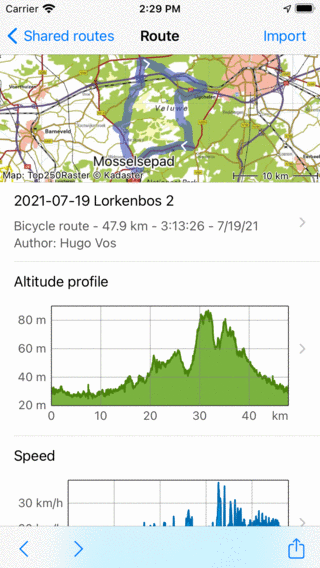
The route details screen of a shared route.
You can use the “<” (previous) and “>” (next) buttons in the bottom toolbar to browse through the list of shared routes. If you want to import a specific route you can tap the “Import” button on the top right.